Public Art at Joyce Station: A StreetBond Install for TransLink
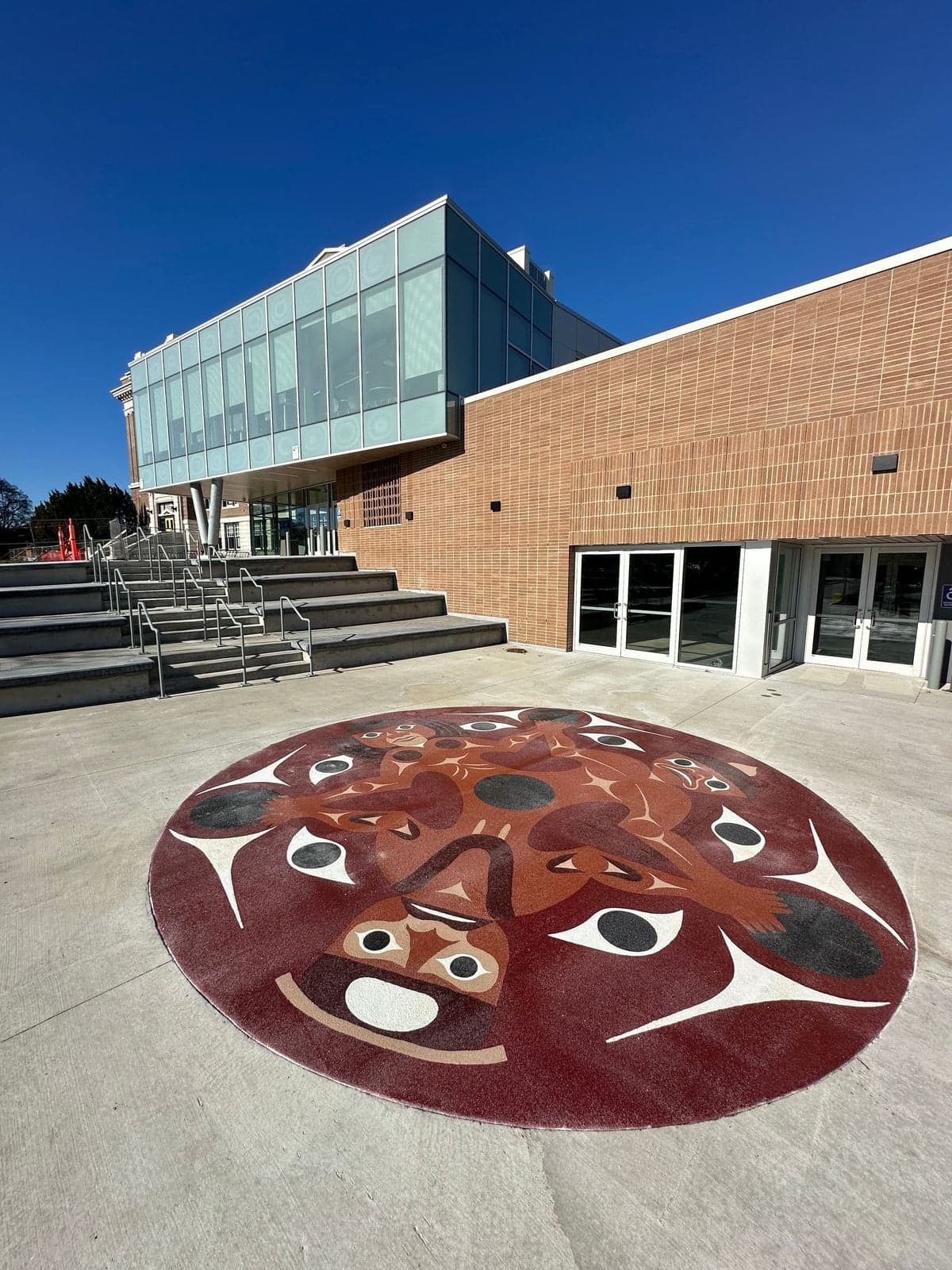
Joyce SkyTrain Station, Vancouver. The concourse surface carries a public art installation by Renée Van Halm — a Dutch-born, Vancouver-based artist — commissioned through TransLink's public art program. The piece runs across the pedestrian transition zones, rendered in StreetBond colour coatings.
We installed it. This is a case study on what transit-scale public art actually requires on the install side.
Why StreetBond for Transit Art
Public art in a SkyTrain station context is an unusual technical problem. The surface has to survive:
- Continuous pedestrian traffic including wheeled luggage and strollers
- Winter salt tracked in from the platform stairs
- Daily wet-cleaning with industrial equipment
- Seven-day-a-week operation with no scheduled resurfacing window
Paint doesn't survive that environment. Tile cracks under thermal cycling and presents a liability for slipping pedestrians. The decision to use StreetBond on this project came from the durability profile — it bonds chemically to the concrete and asphalt substrate, it carries colour through its full depth rather than on top of it, and it tolerates the cleaning regime a transit concourse requires.
Translating Artwork Into Pavement
The artist delivers a vision. Our job is to translate that vision into a finished surface that reads the way the artist intended from every viewing angle a commuter will experience it at.
That translation involves:
Colour matching. StreetBond comes in a deep palette, but custom pigments get mixed for projects like this. Every colour has to be matched to the artist's specification under natural and station lighting, both. We run sample panels on-site before the install date.
Pattern separation. Wet-edge transitions between colours are where an install can succeed or embarrass itself. Masking and sequencing are planned on paper before anyone's on the concourse with a roller.
Substrate preparation. The concrete underneath was not delivered clean. Before any colour coating goes down, the substrate gets vapor-blasted back to a uniform profile — no oil staining, no residual adhesive, no surface weakness that would show through the finished coating as a shadow.
Working Inside an Operating Station
Joyce Station does not close for art installations. The install happened in phased night-work blocks, outside revenue hours, with full reinstatement before the station reopened each morning.
Night work at a transit facility is a choreographed operation. We coordinated with TransLink dispatch, station agents, and security on a nightly basis. Equipment was staged before the last train, work happened in the two-to-three hour active window, and the site was cleared and cured enough to walk on before the first morning departures.
Every panel that went down had to be fully cure-ready before the station opened. That meant the cure window and the overnight work window had to line up exactly. A miscue on either side would have shut down the concourse, which was a non-option.
What's There Now
The concourse reads as intentional. Commuters see a surface that was designed, not defaulted into, and the art carries recognition value for the station in a way that a beige tile floor never would.
From an installer's perspective, the work that holds up at a transit site is the work where the product, the artist's brief, and the site's operational constraints were all solved simultaneously. Joyce Station is in that category.
If you're a transit agency or a public art program evaluating a decorative surface install, we've done work at this scale across the Lower Mainland and Vancouver Island. Request a scope conversation.