Agnes Greenway: Indigenous Art in Pavement for New Westminster
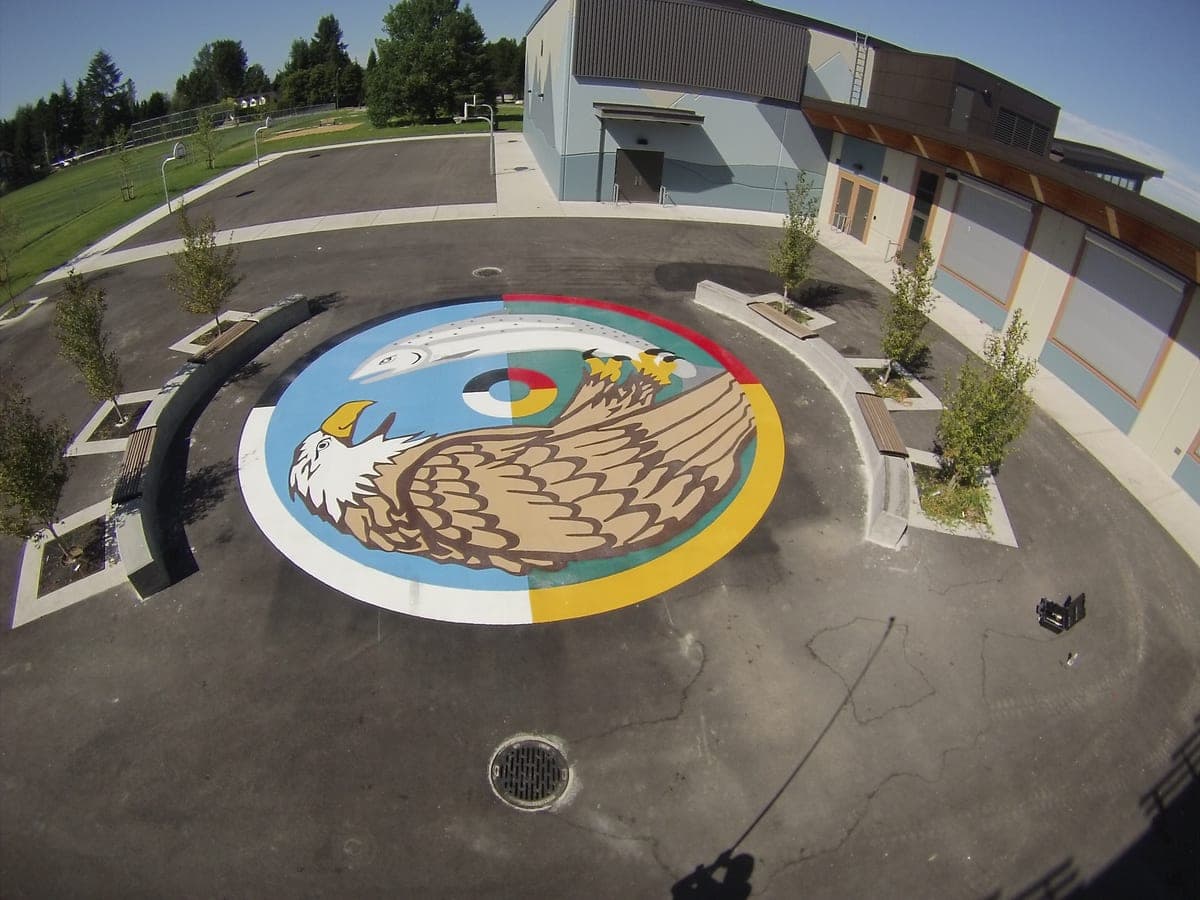
The Agnes Greenway is a pedestrian and cycling corridor running through New Westminster, connecting downtown residential streets to the city's broader active-transportation network. In June 2023 we installed a pavement art piece along the greenway, designed by Rain Pierre, an artist from the Katzie First Nation.
The installation anchors a stretch of the greenway adjacent to École Qayqayt, a school that carries its Halkomelem name as a daily act of acknowledgement. The pavement art continues that acknowledgement in physical form, underfoot, for every student and resident who uses the corridor.
The Artist
Rain Pierre is a Katzie First Nation artist whose work spans carving, painting, and increasingly, applied public art. His designs carry the visual vocabulary of his nation — form lines, animal figures, ancestral symbols — adapted for the scale and material of the site.
When a Katzie artist's work is installed on Katzie territory (New Westminster sits within traditional Katzie lands, shared historically with other Coast Salish nations), the artwork does something that no imported design can do. It marks the ground as the ground the community has always walked.
The Product
We installed the design in TrafficPatterns preformed thermoplastic. The product is engineered for high-pedestrian and low-to-moderate vehicular traffic, which matches the Agnes Greenway use profile: continuous foot and cycle traffic, occasional service-vehicle access, four-season weather exposure.
TrafficPatterns sheets are pre-cut from the artist's artwork at full installation scale. The install process is torch-down — the asphalt and the sheet reach bonding temperature together, and the material fuses into the substrate as it cools. The marking is not a coating. It is part of the pavement.
Expected service life at a greenway site with the Agnes Greenway's traffic profile is in the seven-to-ten-year window at full colour saturation, with gradual softening past that. For civic art attached to an ongoing reconciliation commitment, that service life matters — the artwork doesn't disappear after one winter.
The École Qayqayt Connection
École Qayqayt, the elementary school that anchors the greenway, is named using the Halkomelem name for the land the school is built on. The school's daily practice of centring that name inside student life is a quiet form of reconciliation work, and Rain Pierre's pavement piece complements that work directly.
Students at Qayqayt walk across the installation on their way to school. They ask questions about it. The design enters the visual vocabulary of their daily commute. Over years, that repeated encounter is the kind of exposure that shifts what a community considers normal — and what becomes normal is acknowledgement of the land's first people, rendered as a civic fact rather than a ceremonial gesture.
The Install
Greenway installs have their own operational profile. The corridor stays open for pedestrians where possible — we work in staged sections, closing a section at a time rather than the whole greenway, so the corridor remains functional throughout.
Asphalt preparation on this site was straightforward: the pavement was in good condition, and the substrate accepted the thermoplastic cleanly. Layout was surveyed from reference points the city provided, and we ran the torch-down application in the window between early morning pedestrian traffic and the evening cycling peak.
Colour matching was done against the artist's specification sheets and confirmed with sample panels before the full install proceeded.
What the Greenway Does Now
Since the install, the Agnes Greenway reads as a curated civic corridor rather than as a piece of transportation infrastructure. The art brings an intentionality to the route that a plain asphalt path couldn't carry.
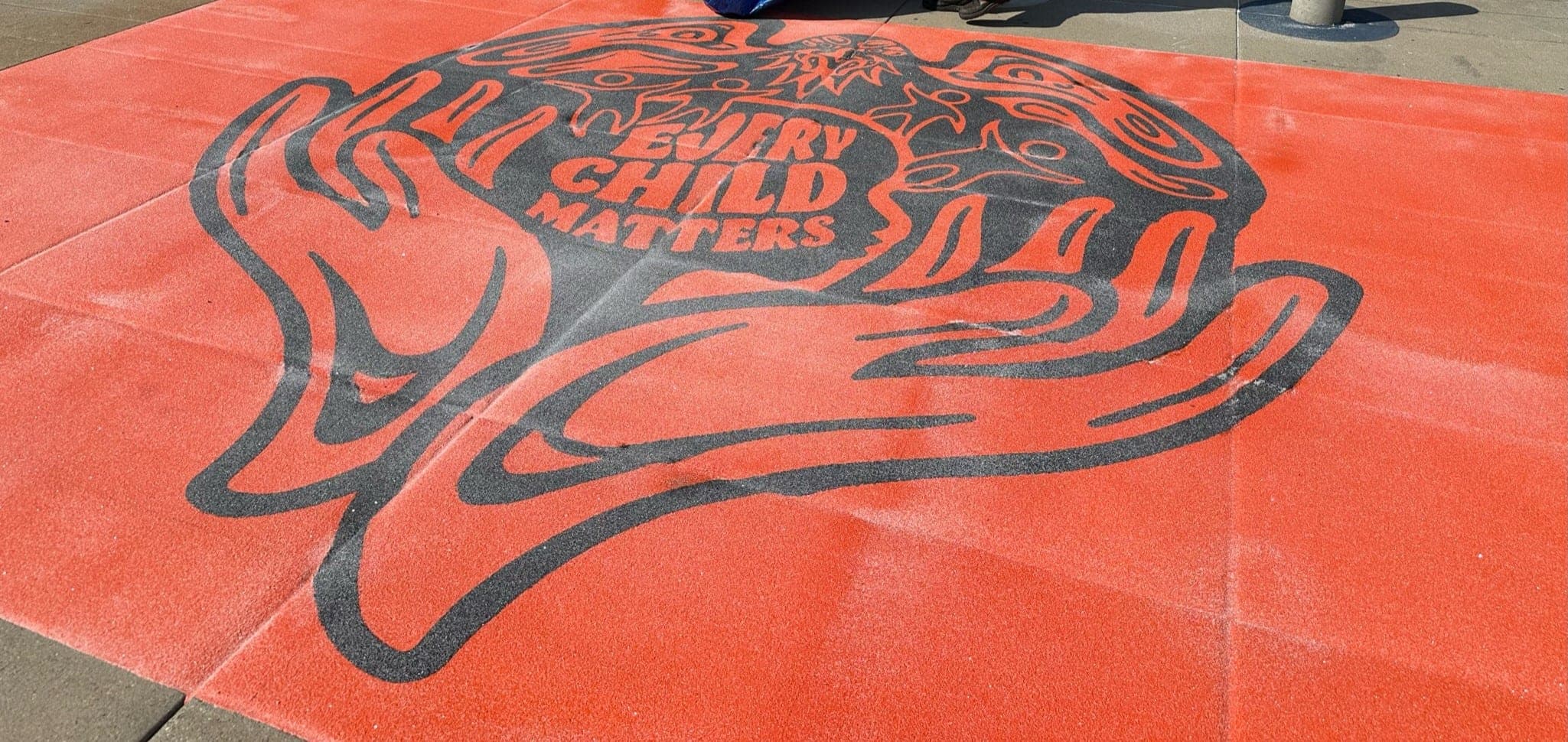
For New Westminster, the installation connects to the city's broader reconciliation and placemaking commitments — the Qayqayt school name, the Every Child Matters installation elsewhere in the city, the ongoing work with local Nations on public-realm visibility.
For us as installers, the Agnes Greenway is the kind of work that expands what a pavement studio can be. We are not only marking lanes and paving parking lots. We are carrying the work of artists and Nations into the physical substrate of the community.
If your municipality is planning a greenway, corridor, or plaza install with First Nations partnership, get in touch. We have done this category of work across the Lower Mainland and Vancouver Island, and we take it seriously every time we are asked.